

by William F. Supple, Jr., Ph.D. aka Ben Fen
Fenbendazole Can Cure Cancer presents Case Reports of people who have treated their own cancers along with other articles to help understand how fenbendazole works to treat cancer. Previous articles covering other cancers and anticancer mechanisms of fenbendazole are in the Archives link.
The greatest discoveries in the history of cancer pharmacology were not made by oncologists looking for cancer drugs. They were made by epidemiologists examining the records of people taking drugs for something else entirely — and noticing that they were getting cancer less often than they should.
If you’ve read Cancer is a Parasite you’ll get more out of this post as it is an extension of some of the discoveries in that book.
Science prefers its discoveries to look like discoveries. A hypothesis is formed, a trial is designed, a result is measured, and a conclusion is announced. The story is clean. The credit is assignable. The funding cycle is justified.
But some of the most important findings in medicine do not arrive that way. They arrive as anomalies in datasets built for a different purpose. They arrive as unexplained reductions in cancer incidence in populations that were being followed for cardiovascular disease. They arrive as statistically improbable survival rates in communities that received mass antiparasitic treatment for intestinal worms. They are found not by people looking for them but by people paying close enough attention to notice that something, in data collected for a completely different reason, does not fit.
Two such discoveries — one involving aspirin, one involving the benzimidazole class of antiparasitic drugs — are among the most compelling and underappreciated signals in contemporary oncology. Both followed the same logical structure. Both emerged from the same kind of inadvertent pharmacovigilance. And both, this paper argues, reveal not a coincidence but a principle: that the biological logic underlying the vulnerability of cancer cells is older, deeper, and more widely shared than the discipline of oncology has been willing to acknowledge.
I. The Aspirin Story: A Cardiac Drug That Prevented Cancer
A Drug for the Heart
Aspirin — acetylsalicylic acid — was first synthesized in 1853 and brought to market by Bayer in 1897. For most of the twentieth century it was understood as three things: an analgesic, an antipyretic, and an anti-inflammatory agent. The mechanism behind all three effects — irreversible inhibition of cyclooxygenase enzymes and consequent reduction of prostaglandin synthesis — was not fully characterized until John Vane’s work in the early 1970s, work that earned him the Nobel Prize in Physiology or Medicine in 1982 (Patrono et al., 2013).
What emerged from that mechanistic understanding was a fourth application. By permanently acetylating the COX-1 enzyme in platelets — which, as anucleate cells, cannot synthesize new enzyme — aspirin permanently inhibits platelet aggregation for the lifetime of that platelet, approximately eight to ten days. This antiplatelet mechanism made aspirin the foundational drug in the secondary prevention of myocardial infarction and ischemic stroke, prescribed daily to tens of millions of patients in cardiovascular medicine across the developed world (Elwood et al., 1974). By the 1980s, those patients constituted an enormous, geographically diverse, carefully followed, and extensively documented population. They were not cancer patients. They were cardiac patients. And they began, quietly, to develop cancer at lower rates than expected.
Melbourne, 1988: The First Signal
The first clinical evidence emerged in 1988 from a case-control study conducted in Melbourne, Australia — the Melbourne Colorectal Cancer Study — published in Cancer Research. The study was led by Kune and colleagues and was designed to examine risk factors for colorectal cancer. Aspirin use appeared in the data as a protective variable: aspirin users developed colorectal cancer significantly less often than non-users (Kune et al., 1988).
The study was not designed to test aspirin as an anticancer drug. It was an observational study, and the aspirin finding was, in the most literal sense of the word, incidental. Kune and colleagues reported it because it appeared in the data and because the signal was too strong to ignore. The IARC and the broader oncology community received it with the skepticism that observational findings in non-randomized populations routinely attract. But the signal was real.
The first evidence that aspirin might prevent cancer was discovered in a dataset built to study something else. Nobody was looking for it. Somebody noticed it. That distinction matters enormously for understanding how pharmacological discovery actually works.
The American Cancer Society Cohort, 1991
Three years after the Melbourne study, Thun and colleagues published a landmark prospective analysis in the New England Journal of Medicine. The dataset was the American Cancer Society’s Cancer Prevention Study II — 662,424 adults who had provided information in 1982 on the frequency and duration of their aspirin use. Death rates from colon cancer were tracked through 1988. The relative risk of fatal colon cancer among persons who used aspirin 16 or more times per month for at least one year was 0.60 in men — a 40% reduction in colon cancer mortality across more than 600,000 people (Thun et al., 1991).
This was not a curated clinical trial cohort. This was America in the 1980s — people taking aspirin for arthritis, for headaches, for heart attacks they had already survived. They were not selected for compliance or tolerability or the absence of comorbidities. They were enrolled because they were alive and willing to complete a questionnaire. And across all of them, the cancer signal held.
The Harvard Cohorts
The Nurses’ Health Study and the Health Professionals Follow-Up Study, encompassing a combined 130,274 participants, provided data on aspirin use from questionnaires administered every two years across the 1990s and 2000s (Chan et al., 2008). These were not cancer trials. They were prospective cohort studies of general health, with aspirin use captured as a background variable among people taking it primarily for cardiovascular indications. The cancer findings were a byproduct of a surveillance infrastructure built for a different purpose — precisely as the benzimidazole cancer signal would later emerge from a parasitic disease surveillance infrastructure built for a different purpose.
By the early 2000s, the epidemiological evidence had accumulated to the point where it could no longer be treated as incidental. A quantitative review reported a 30% reduction in colorectal cancer risk (relative risk 0.73), and also found evidence — though more limited and mainly from case-control studies — that aspirin had favorable effects on cancers of the esophagus, stomach, breast, ovary, and lung (Bosetti et al., 2012). The cancer-preventive effect of aspirin was not limited to colorectal cancer. It was a broader oncological signal that happened to be most visible in the gastrointestinal tract, but touched multiple organ systems.
The Rothwell Confirmation
The definitive confirmation came from data that had never been collected to study cancer. Peter Rothwell and colleagues at Oxford performed long-term follow-up analyses of patients enrolled in randomized controlled trials of aspirin for cardiovascular disease prevention. These patients had been followed for years as part of cardiac trials. Rothwell analyzed their cancer outcomes. In a 2010 Lancet paper, he reported that long-term aspirin use significantly reduced colorectal cancer incidence and mortality in pooled follow-up data from five randomized cardiovascular trials (Rothwell et al., 2010). His subsequent 2011 Lancet series extended the finding across multiple cancer types.
This is the critical epistemological point. The proof did not come from an oncology trial. It came from cardiovascular trial data that had been sitting in databases for decades. The anticancer signal was in the data all along. It waited twenty-two years — from Melbourne in 1988 to Rothwell in 2010 — to be fully confirmed, because no one had specifically designed a trial to look for it. When the confirmation came, it came from evidence collected for a completely different reason.
II. The Benzimidazole Story: An Antiparasitic Drug That Fights and Prevents Cancer
A Drug for Worms
Mebendazole and fenbendazole are benzimidazole carbamate anthelmintics — drugs developed in the 1970s to treat intestinal nematode infections in both humans and animals. Their mechanism is precise and well-characterized: they bind selectively to beta-tubulin in parasitic organisms, preventing microtubule polymerization, disrupting the mitotic spindle, collapsing intracellular transport, and thereby blocking cell division (Dogra et al., 2018). By 1987, the WHO had included mebendazole on its Model List of Essential Medicines, and over the following decades it became one of the most widely distributed drugs in the world through mass drug administration programs targeting soil-transmitted helminthiasis in sub-Saharan Africa, South Asia, and Southeast Asia.
The exposed populations in these programs were enormous. The WHO’s preventive chemotherapy programs — distributing mebendazole and albendazole (very similar to fenbendazole) to school-age children and at-risk adults — reached hundreds of millions of people annually across dozens of countries. These programs were not cancer programs. They were parasitic disease control programs. The cancer signal that emerged from them was, like the aspirin signal that emerged from cardiac cohorts, entirely unintentional.
The AntiCancer Signal Blares
The benzimidazole anticancer story is structurally younger than the aspirin story — its primary evidentiary base consists of preclinical data, case reports, and retrospective epidemiological analyses rather than the kind of large-scale randomized confirmation that Rothwell provided for aspirin. But the preclinical evidence is striking and mechanistically coherent. Fenbendazole has been shown to exert anticancer activity across multiple cell lines by modulating pathways including microtubule disruption, glycolysis inhibition, Wnt/beta-catenin pathway suppression, and apoptosis induction (Dogra et al., 2018). Mebendazole has demonstrated similar multimodal activity, with particular efficacy against colorectal, lung, and brain tumor models.
As discovered and detailed in Cancer is a Parasite cancer incidence rates vary greatly around the world. With cancer at least ½ as prevalent in nations that have public health programs involving mass drug administration (MDA) of antiparasitic drugs to control worm infestations (Supple, 2026). This cancer incidence gap is not due to genetic, dietary, geographic, or detection differences. The 123 nations that deworm include India, Mexico, Nigeria, Oman, Argentina; nations that are so different in every respect except that they all use MDA of antiparasitics.
In contrast, the 61 nations that do not use MDA of antiparasitics are wealthy developed nations like the US, Australia, EU, Israel. Incidentially, it is not the case that these developed nations are free of parasite infestation, they are absolutely infected at epidemic levels as warned by a series of CDC papers published from 2012-2015. For example, Peter Hotez and his colleagues at the CDC determined that over 60 million Americans are infected with toxoplasma gondii alone (Parise et al., 2014; Despommer et al., 2017)!
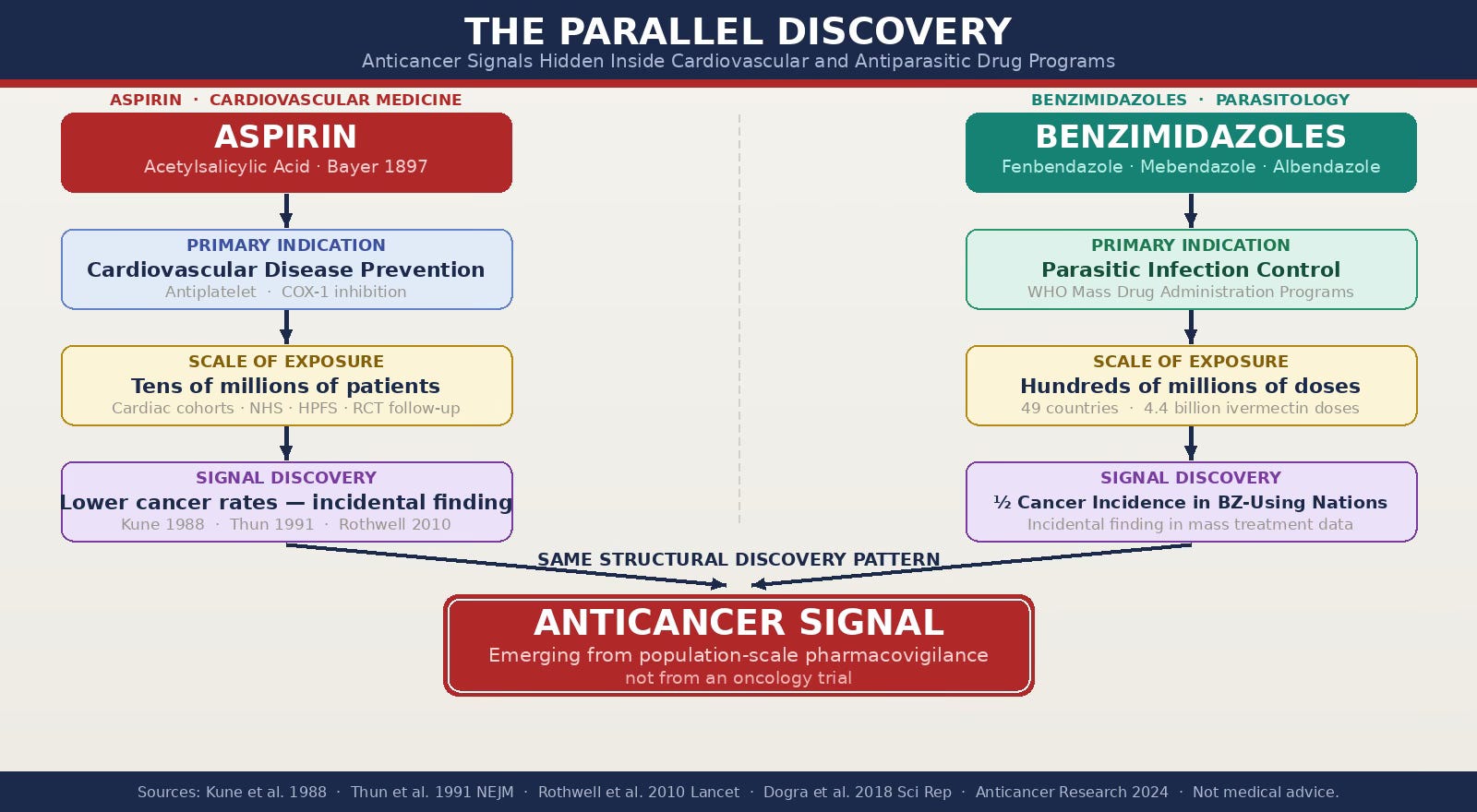
The parallel to the aspirin story is structural. In both cases, a drug administered to enormous numbers of people for a non-oncological indication began to show cancer-protective effects in the residue of data generated for a different surveillance purpose. In the aspirin case, the exposed population was the cardiovascular medicine community of the developed world. In the benzimidazole case, the exposed population was the parasitic disease community of the developing world — a population even larger, if considerably harder to follow prospectively.
The Joe Tippens Case, Fenbendazole Can Cure Cancer Substack, Dr. Makis and Social Media Amplification
The contemporary public awareness of fenbendazole’s potential anticancer properties traces originally to a 2019 account by Joe Tippens, an American cancer patient who reported complete remission of stage IV small cell lung cancer following self-administration of fenbendazole at 222 mg orally, alongside vitamin E succinate, CBD oil, and curcumin. Tippens was simultaneously enrolled in a clinical trial for a novel immunotherapy agent, introducing a significant confounder (Nyugen et al., 2024; Supple, 2026). The case is anecdotal and uncontrolled. It is also, given everything that followed in the preclinical literature, not implausible.
Starting in 2021, this Substack then amplified the Tippens’ message with dozens of Case Reports showing dramatic outcomes when people with various cancers self-treated with fenbendazole when standard of care treatments failed. Some of those Case Reports were published in the peer-reviewed cancer journal Case Reports in Oncology by Makis, Bagli & Martinez in 2025. That was subsequently retracted by Pharma, not due to scientific integrity, but because of politics. Makis, an oncologist, got turned onto fenbendazole in 2024 and has treated many patients to great effect ever since.
The signal is accumulating.
III. The Structural Parallel
The resemblance between the two stories is not superficial. It reflects a deep structural feature of how pharmacological discovery works when the drug in question is cheap, off-patent, widely distributed, and not owned by anyone with a financial incentive to run the cancer trial that would confirm what the observational data already suggests.
In both cases, the drug was being given to vast numbers of people for a completely different reason. In both cases, a cancer signal appeared in the residue of data collected for that other reason. In both cases, the initial response from institutional medicine was skepticism rooted in the observational character of the evidence. In both cases, the signal has been progressively confirmed by accumulating evidence from multiple methodologically distinct sources — case-control studies, prospective cohorts, randomized trial follow-up, meta-analyses, and in the benzimidazole case, a rapidly growing body of preclinical mechanistic work.
In both cases, the randomized confirmatory trial — the gold standard that institutional medicine requires before changing clinical practice — has been slow to materialize, precisely because the drugs are off-patent and therefore unable to generate the commercial return that funds the kind of large-scale trials that would settle the question. This is not a conspiracy. It is a structural feature of how pharmaceutical research is funded: the trial that would make the clearest possible case for fenbendazole or low-dose aspirin as adjunctive cancer therapies would also eliminate the possibility of patenting the finding, and therefore eliminate the financial incentive for any commercial entity to fund it.
The same economic logic that delayed aspirin’s recognition as a cancer-preventive agent for twenty-two years is currently delaying the recognition of benzimidazoles. The difference is that we can now see the pattern, name it, and argue against it.
IV. Where the Parallel Breaks — and Why That Matters
The aspirin story and the benzimidazole story share their discovery structure. But they diverge, instructively, at the level of mechanism. And that divergence illuminates something important about the deeper thesis underlying the benzimidazole anticancer case.
With aspirin, the mechanism of cardiovascular protection and the mechanism of cancer protection turn out to be the same mechanism — platelet COX-1 inhibition. The dose that prevents heart attacks (75 to 81 mg daily) is the same dose that prevents cancer. Colorectal cancer and atherothrombosis share a common pathological substrate: enhanced platelet activation in response to injury at distinct sites (Patrono, 2016). The same target, the same drug effect, the same pharmacological logic. Mechanistic convergence.
With benzimidazoles, the conventional framing would say the opposite: that the antiparasitic mechanism (tubulin disruption in nematodes) and the anticancer mechanism (tubulin disruption in cancer cells) are incidentally similar — that the drugs happen to attack a vulnerability in cancer cells that happens to resemble a vulnerability in parasites, but that the two are, at the level of biological causation, unrelated.
This is exactly wrong, and the argument of the book Cancer Is a Parasite (Supple, 2026) makes the case for why. The mechanisms are not incidentally similar. They are identical because cancer cells and parasitic organisms are expressing the same biological logic — the logic of uncontrolled proliferative organisms that have evolved strategies to evade host immune clearance and sustain themselves at the host’s metabolic expense.
Consider the specific mechanisms by which benzimidazoles attack both parasites and cancer cells. Tubulin disruption is the primary antiparasitic mechanism: the drugs bind to beta-tubulin in parasitic organisms, preventing microtubule polymerization and disrupting mitosis (Dogra et al., 2018). The anticancer mechanism is identical in molecular terms: the same drugs bind to beta-tubulin in cancer cells, achieving the same disruption of mitotic spindle formation, through the same binding site on the same protein. Glycolysis inhibition: parasitic helminths, operating in oxygen-poor environments, are characteristically dependent on anaerobic glycolysis. Fenbendazole disrupts glucose uptake and glycolytic flux in helminths via GLUT1 downregulation and hexokinase interference. Cancer cells exhibit the same preferential reliance on aerobic glycolysis — the Warburg effect — for the same biological reasons, and fenbendazole inhibits their glycolysis through the same mechanism (Warburg, 1956; Dogra et al., 2018). Wnt/beta-catenin pathway disruption: Wnt signaling governs proliferation and immune evasion in both helminthic infections and colorectal, hepatocellular, and multiple other cancer types. Benzimidazoles modulate this pathway in both contexts — not coincidentally, but because it is the same pathway serving the same biological function in what are, by this thesis, the same class of organism.
The aspirin parallel is therefore mechanistically unified at one level — the same drug target for cardiovascular and oncological protection — while the benzimidazole thesis achieves a deeper unification: the drug target is the same because the underlying biological entities are expressing the same evolutionary survival strategy. Not the same pathway exploited coincidentally. The same pathway exploited because it is the same solution to the same problem, evolved independently but converging on identical molecular machinery.
V. What History Teaches
The aspirin story took twenty-two years from the first observational signal to randomized confirmation. In that twenty-two years, hundreds of thousands of people developed colorectal cancers that might have been prevented if the institutional machinery for evaluating off-patent drugs had been capable of acting on the observational evidence without waiting for the kind of trial that nobody had a financial incentive to run.
The benzimidazole story is younger. The observational and preclinical evidence is accumulating, but the randomized confirmation that institutional oncology requires has not yet arrived. Based on the aspirin precedent, it may not arrive for another decade or more — not because the signal is absent, but because the incentive structure of pharmaceutical development is poorly suited to confirming the therapeutic value of cheap, widely available, off-patent compounds.
This is the historical lesson that the parallel demands. The IARC evaluated the aspirin-cancer evidence in 1997 and again in 2001 and concluded there was promising evidence but insufficient randomized data (Elwood et al., 2011). That conclusion was correct by the standards of evidence-based medicine as conventionally practiced. It was also, from the perspective of cancer prevention, a delay that cost lives. The same judgment will be applied to benzimidazoles, probably for the same length of time, for the same structural reasons.
The appropriate response to this pattern is not to abandon the standards of evidence — randomized controlled trials remain the gold standard for establishing causation, and the observational evidence for benzimidazoles, though compelling, is not yet at the level of the Rothwell cardiovascular trial meta-analyses. The appropriate response is to recognize the pattern, name it explicitly, and advocate loudly for the publicly funded research infrastructure that would allow the confirmatory trials to happen without requiring a patent-holder to fund them.
Aspirin is now widely recognized as one of the most cost-effective cancer-prevention tools available. The US Preventive Services Task Force has issued guidance on aspirin for colorectal cancer prevention. The conversation has shifted from ‘is this real?’ to ‘who should take it and at what dose?’ That shift took twenty-two years and the publication of the Rothwell analyses. The benzimidazole conversation needs to get there faster. The historical precedent is clear. The biological mechanism is coherent. The population-level signal, fragmented and observational though it currently is, is pointing in one direction.
In both the aspirin story and the benzimidazole story, the discovery arrived not because medicine went looking for it, but because the data was large enough and the observers attentive enough to see what was already there. The question now is whether institutional medicine will wait another twenty years to act on what the data already shows — or whether the lesson of aspirin will be learned in time.
Conclusion
The anticancer signal in aspirin was found hiding inside the records of cardiovascular medicine. The anticancer signal in benzimidazoles was found hiding inside the records of parasitic disease control. In both cases, the drug was cheap. In both cases, the drug was widely distributed. In both cases, the signal emerged not from an oncology hypothesis but from the attentive examination of data collected for a different purpose. In both cases, the confirmation was delayed by the absence of a commercial incentive to run the confirmatory trial. And in both cases, the mechanism, once understood, revealed not a coincidence but a principle — that cancer cells and the organisms against which these drugs were designed share vulnerabilities deep enough that the same drug, administered for the same reason, protects against both.
The book Cancer Is a Parasite (Supple, 2026) makes the mechanistic case for why that sharing is not coincidental. The present analysis makes the epidemiological and historical case for why the signal has been visible for decades in population-level data that predates the molecular understanding. Together, they constitute an argument not just for the therapeutic potential of benzimidazoles in oncology, but for a fundamental reorientation of how cancer is understood, studied, and treated — one that takes seriously the possibility that cancer is not a disease that happens to share some features with parasitism, but a parasitic process that happens to arise from within the host’s own cells.
The aspirin story took twenty-two years. The benzimidazole story should not have to.
References
Bosetti, C., Rosato, V., Gallus, S., Cuzick, J., & La Vecchia, C. (2012). Aspirin and cancer risk: A quantitative review to 2011. Annals of Oncology, 23(6), 1403–1415. https://doi.org/10.1093/annonc/mds113
Chan, A. T., Giovannucci, E. L., Meyerhardt, J. A., Schernhammer, E. S., Wu, K., & Fuchs, C. S. (2008). Aspirin dose and duration of use and risk of colorectal cancer in men. Gastroenterology, 134(1), 21–28. https://doi.org/10.1053/j.gastro.2007.09.035
Chan, A. T., Ogino, S., & Fuchs, C. S. (2007). Aspirin and the risk of colorectal cancer in relation to the expression of COX-2. New England Journal of Medicine, 356(21), 2131–2142. https://doi.org/10.1056/NEJMoa067208
Despommier, D. D., Griffin, D. O., Gwadz, R. W., Hotez, P. J., & Knirsch, C. A. (2017). Parasitic Diseases(7th ed.). Parasites Without Borders
Dogra, N., Kumar, A., & Mukhopadhyay, T. (2018). Fenbendazole acts as a moderate microtubule destabilizing agent and causes cancer cell death by modulating multiple cellular pathways. Scientific Reports, 8(1), 11926. https://doi.org/10.1038/s41598-018-30158-6
Elwood, P. C., Cochrane, A. L., Burr, M. L., Sweetnam, P. M., Williams, G., Welsby, E., Hughes, S. J., & Renton, R. (1974). A randomized controlled trial of acetyl salicylic acid in the secondary prevention of mortality from myocardial infarction. British Medical Journal, 1(5905), 436–440. https://doi.org/10.1136/bmj.1.5905.436
Elwood, P. C., Morgan, G., Galante, J., Chia, J. W. K., Cantwell, M., Watkins, J., Dolwani, S., Zampieri, S., & Yü, C. K. (2021). Aspirin and cancer survival: A systematic review and meta-analyses of 118 observational studies of aspirin and 18 cancers. Ecancer, 15, 1258. https://doi.org/10.3332/ecancer.2021.1258
Kune, G. A., Kune, S., & Watson, L. F. (1988). Colorectal cancer risk, chronic illnesses, operations, and medications: Case control results from the Melbourne Colorectal Cancer Study. Cancer Research, 48(15), 4399–4404.
Makis, W., Baghli, I., & Martinez, P. (2025). Fenbendazole as an Anticancer Agent? A Case Series of Self-Administration in Three Patients. Case reports in oncology, 18(1), 856–863. https://doi.org/10.1159/000546362
Nguyen, J., Nguyen, T. Q., Han, B. O., & Hoang, B. X. (2024). Oral Fenbendazole for Cancer Therapy in Humans and Animals. Anticancer research, 44(9), 3725–3735. https://doi.org/10.21873/anticanres.17197
Parise, M. E., Hotez, P. J., & Slutsker, L. (2014). Neglected parasitic infections in the United States: Needs and opportunities. The American Journal of Tropical Medicine and Hygiene 90, no. 5: 783–85. doi.org/10.4269/ajtmh.13-0727
Patrono, C., Morais, J., Baigent, C., Bhatt, D. L., Brotons, C., Cannon, C. P., Cosentino, F., De Caterina, R., Fuster, V., Herings, R., Joner, M., Rocca, B., Sinnaeve, P., Taubert, K., Verheugt, F., & Wallentin, L. (2013). Antiplatelet agents for the treatment and prevention of coronary atherothrombosis. Journal of the American College of Cardiology, 64(14), 1457–1476. https://doi.org/10.1016/j.jacc.2014.07.040
Patrono, C. (2016). Aspirin and cancer: An evolving story. Journal of the American College of Cardiology, 68(9), 967–976. https://doi.org/10.1016/j.jacc.2016.05.083
Rothwell, P. M., Wilson, M., Elwin, C. E., Norrving, B., Algra, A., Warlow, C. P., & Meade, T. W. (2010). Long-term effect of aspirin on colorectal cancer incidence and mortality: 20-year follow-up of five randomised trials. Lancet, 376(9754), 1741–1750. https://doi.org/10.1016/S0140-6736(10)61543-7
Supple, W. F., Jr. (2026). Cancer is a Parasite: Kill it with the Safe, Over-the-Counter Antiparasitic Fenbendazole. Skyhorse/MAHA Books.
Thun, M. J., Namboodiri, M. M., & Heath, C. W. (1991). Aspirin use and reduced risk of fatal colon cancer. New England Journal of Medicine, 325(23), 1593–1596. https://doi.org/10.1056/NEJM199112053252301
Thun, M. J., Jacobs, E. J., & Patrono, C. (2012). The role of aspirin in cancer prevention. Nature Reviews Clinical Oncology, 9(5), 259–267. https://doi.org/10.1038/nrclinonc.2011.199
Warburg, O. (1956). On the origin of cancer cells. Science, 123(3191), 309–314. https://doi.org/10.1126/science.123.3191.309Thanks for reading Fenbendazole Can Cure Cancer! This entire Substack is free so share it with all who may benefit.
Cancer is a Parasite Book Notes
Cancer is a Parasite is the #1 book in many Amazon categories like breast, lung and prostate cancer! The book is not in Barnes and Noble stores, which is obviously a huge disappointment. Some experts and others familiar with the business say that this is not unusual in that BN ceased being a primary bookstore long ago now focusing on calendars, gifts and stationary. Amazon is the place where books are sold. If you buy it on Amazon, please post your reactions and review on Amazon - a few words is all it takes. I think you can post comments on Amazon even if you obtained the book elsewhere. I would also ask that you comment here as well and as always, ask any questions that arise.

We are truly at a moment in time where a legitimate cure for cancer is about to enter the mainstream. The stars are aligned and the time is ripe for a real cure like fenbendazole. The ball is now in the court of the revamped Health and Human Services public health infrastructure. It is my hope that the shackles impeding progress from entrenched interests have been loosened enough to find the political will and courage to act in humanity’s best interests. It is truly a great time to be alive!
Here is the link to the book at Amazon Cancer is a Parasite
Items Included in All Posts
Fenbendazole vs. Mebendazole vs. Albendazole vs. Flubendazole: The benzimidazoles are very similar chemically and they have very similar mechanisms of action with respect to disrupting microtubule function, specifically defined as binding to the colchicine-sensitive site of the beta subunit of helminithic (parasite) tubulin thereby disrupting binding of that beta unit with the alpha unit of tubulin which blocks intracellular transport and glucose absorption (Guerini et al., 2019). If someone asks you how fenbendazole kills the cancer cells, the answer is in italics in the previous sentence.

The class of drugs known as benzimidazoles includes fenbendazole, mebendazole, albendazole and flubendazole. Mebendazole is the form that is approved for human use while fenbendazole is approved for veterinary use. The main difference is the cost. Mebendazole is expensive ~$555 per 100 mg pill, while fenbendazole is inexpensive ~48 cents per 222 mg free powder dose (Williams, 2019). As you may recall, albendazole is the form used to treat intestinal parasites in India and these cost 2 cents per pill. FYI, to illustrate how Americans are screwed by Big Pharma, two pills of mebendazole cost just $4 in the UK, 27 cents per 100 mg pill in India and $555 per 100 mg pill in the US.
While most of the pre-clinical research uses mebendazole, probably because it is the FDA-approved-for-humans form of fenbendazole, virtually all of the self-treating clinical reports involve the use of fenbendazole. Because the pre-clinical cancer studies use mebendazole (ironically the human form of fenbendazole) and humans self-treat their cancers with fenbendazole (the animal form of mebendazole) it is very reasonable to assume that mebendazole and fenbendazole are functional equivalents with respect to cancer. It would be helpful if future pre-clinical and clinical investigations simply used fenbendazole as a practical matter. For the purposes of this Substack, fenbendazole, mebendazole and albendazole are used interchangably.
Where to get fenbendazole
In our experience and the experiences of those that write in, it appears that the three readily available brands of fenbendazole (Panacur-C, FenBen Labs, Happy Healing Labs) are equally effective. Panacur-C can be obtained locally in pet stores, while they all can be obtained from Amazon. The article on Questions & Answers discusses the brands of fenbendazole in detail and shows photos of the various brands referenced.
If you would like to report your experiences with fenbendazole you can do so privately by email myfenbendazole@proton.me or more publicly in the Comments section in any of the articles. Also, if you know of people who’ve tried fenbendazole, and it didn’t work, we’d be especially interested in hearing from you now. Understanding the conditions and factors that enhance or impede the success of fenbendazole in treating cancer are valuable.
Disclaimer:
Statements on this website have not been evaluated by the Food and Drug Administration. The contents of this website is for educational and informational purposes only and is not intended to be a substitute for professional medical advice, diagnosis or treatment. This website does not provide any kind of health or medical advice of any kind. Always seek the advice of your physician or other qualified health provider with any questions you may have regarding a medical condition. The case reports presented reflect the real-life experiences and opinions of other readers or users of the website. The experiences of those readers or users are personal to those particular readers/users and may not necessarily be representative of all readers/users. We do not claim, and you should not assume, that all other readers/users will have the same experiences. Do your own research, consult with relevant medical professionals before attempting to self-treat for any condition.
IMO Peter Hotez belongs in the cell next to Fauci. I wouldn't believe a word he says.
Thank you so much for your work. I know you came out of retirement to do this. I loved your interview with Dr Robert Yoho. My husband died unnecessarily 13 years ago from cancer and I sure do wish I had known then what I know now. Bless you for stopping needless suffering. You’re such a great writer and researcher. Thank you again so much for your work!